
Dr. Robert Eisen is an esteemed dentist with a wealth of experience in the field. His commitment to excellence is evident through his involvement in various professional associations and dental study groups. He further honed his expertise with a post-graduate program in Cosmetic Dentistry at the University of Buffalo in 1995 and by graduating from the prestigious Pankey Institute, a world-renowned post-graduate dental training facility. Beyond his professional accomplishments, Dr. Eisen is deeply committed to serving the community, contributing to establishing a Dental Clinic for disadvantaged youth in Toronto, ON. His passion for dentistry and patient compassion make him a highly regarded and trusted practitioner.
Sedation and Sleep Dentistry in Barrie: Your Guide to Comfortable Dental Care
Sedation dentistry in Barrie is delivered at three distinct depths: inhaled nitrous oxide, an oral benzodiazepine tablet, and intravenous sedation titrated in increments through a line that stays in place until discharge criteria are met. Patients searching for sleep dentistry are describing the same thing, not general anesthesia: at every one of these levels you continue to breathe independently and respond to verbal instruction. The practical differences are recovery and supervision: nitrous oxide clears in about five minutes on oxygen, and most patients drive themselves home, whereas the other two require a responsible adult escort and no driving for the rest of the day. Every level, including nitrous oxide, requires individual authorization from the provincial regulator, and the deeper two also require a sedation facility permit that any patient can verify on the public register before booking.
Key Takeaways
- "Sleep dentistry" is a patient-facing term, not a clinical one. In practice, it describes minimal to moderate sedation, during which you can still respond to instructions and breathe on your own.
- Three options are available at our clinic: inhaled nitrous oxide, oral sedative tablets, and intravenous sedation, each producing a different depth of relaxation and recovery profile.
- Intravenous sedation is the only option that can be adjusted precisely during treatment, because the drug is titrated in small increments through a line that stays in place until discharge.
- Every level of sedation in Ontario, including nitrous oxide, requires individual authorization from the provincial regulator, and deeper modalities also require a facility permit for the clinic itself.
- Nitrous oxide clears quickly enough that most patients drive themselves home. Oral and intravenous sedation both require a responsible adult escort and no driving for the rest of the day.
- Fees depend on the sedation method and the appointment length, so obtaining a written estimate and an insurance predetermination before treatment help prevent unwelcome surprises.
Find our Dental Clinic Near You
What Is Sedation Dentistry?
Sedation dentistry is the use of pharmacological agents to reduce awareness, anxiety, and physical reactivity during dental treatment, while local anesthetic continues to block pain. The distinction matters because sedation and freezing solve two different problems. Understanding the vocabulary also helps you compare what different clinics are actually offering.
Clinically, sedation is described as a continuum rather than a set of separate states. Sedation dentistry at the minimal level leaves cognitive function only modestly impaired, with breathing and circulation unaffected. Moderate sedation goes further, and professional anesthesia guidance defines it as a state in which patients still respond purposefully to verbal commands, either alone or with light tactile stimulation. Deep sedation and general anesthesia sit beyond that boundary and belong in a hospital or a specially permitted anesthesia facility, not in a routine dental appointment.
Sedation Dentistry Compared with "Sleep Dentistry"
Sleep dentistry is the phrase most patients use when they call our clinic, and it usually signals a wish to remember as little as possible rather than a request for general anesthesia. The confusion is understandable, since benzodiazepine sedatives produce anterograde amnesia, which means many patients genuinely recall almost nothing of a two-hour appointment even though they answered questions throughout it.
Types of Sedation We Offer in Barrie
Choosing a sedation method is a clinical decision that balances the depth of relaxation you need against the length of the procedure, your medical history and how quickly you want to return to normal activity. The three modalities below differ in route of administration, in how precisely they can be adjusted during treatment and in what happens afterwards. Reviewing each one in turn makes the comparison table at the end of this section easier to interpret.
Access to all three modalities within a single practice is less common than patients assume. A survey of 1,076 Ontario dentists published in the Journal of the Canadian Dental Association found that intravenous sedation accounted for 7.2% of reported sedation use, compared with 17.1% for nitrous oxide, and that lack of training was the single most-cited reason for not offering these services at all. The pattern is straightforward: nitrous oxide and oral sedation require the least additional training and carry the lowest operational cost, so they are the modalities most practices adopt first. That is why patients needing intravenous sedation are frequently referred elsewhere, and why the same survey identified long wait times and travel distance to a referral source as barriers in their own right.
Nitrous Oxide (Laughing Gas)
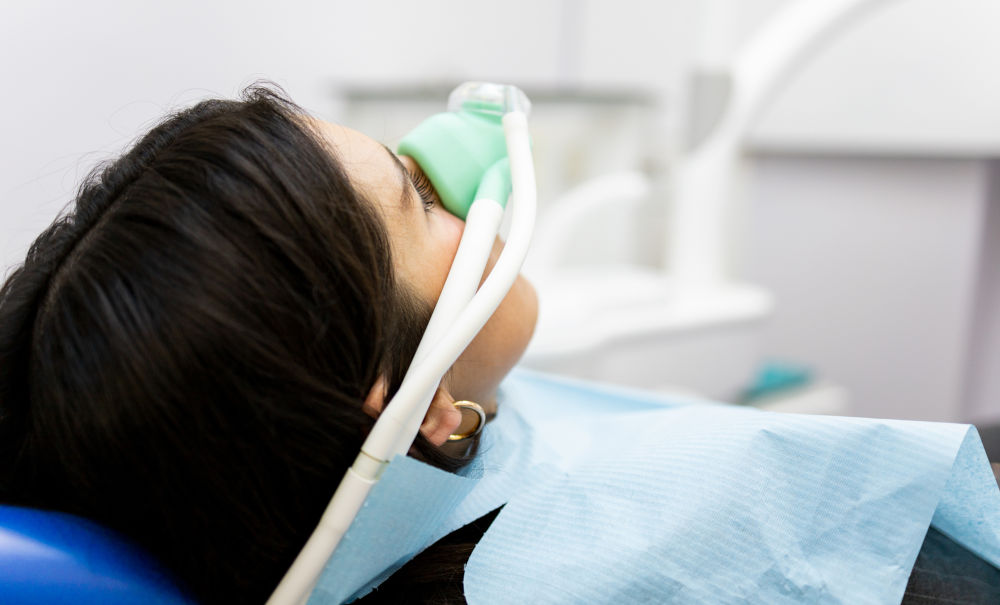
Nitrous oxide is delivered as a blended mixture of nitrous oxide and oxygen through a small nasal hood, and the concentration is adjusted breath by breath until the patient reports the warm, slightly detached sensation that signals an adequate effect. A laughing gas dentist works with equipment that includes a fail-safe system that prevents delivery of less than 30 percent oxygen, along with a scavenging circuit that removes exhaled gas from the operatory air. Effects begin within a few minutes and are reversed by breathing pure oxygen at the end of the appointment.
This modality suits mild to moderate apprehension, shorter restorative visits, children who need help sitting still and patients who cannot arrange an escort. It does not eliminate awareness, and patients who want to remember nothing at all are generally better served by one of the other two options.
Oral Sedation
Oral sedation dentistry relies on a benzodiazepine tablet taken before the appointment, usually about an hour beforehand, so that peak effect coincides with the start of treatment. The result is a calm, drowsy patient who responds to instruction but has limited recall afterwards. Because the drug is absorbed through the gastrointestinal tract, onset and intensity vary with metabolism, body composition and what was eaten that day.
That variability is the main clinical limitation. Once a tablet has been swallowed, the dose cannot be reduced, and additional dosing during the appointment moves the patient into a deeper category of sedation with correspondingly stricter monitoring requirements. Oral sedation therefore works best for predictable appointments of moderate length, and it always requires an escort, since coordination and judgment remain impaired for several hours.
IV Sedation (Administered by Dr. Guorgui)
Intravenous sedation is the deepest modality offered outside a hospital setting and the one that gives the clinician the most control. An indwelling line is established in the arm or hand, the sedative is introduced directly into the bloodstream, and the effect is assessed and extended incrementally rather than committed to in advance. This is the technique most patients have in mind when they look for an IV sedation dentist for surgical treatment.
As Dr. Amir Guorgui, who administers intravenous sedation for surgical and implant cases at our Barrie location, explains: "Intravenous sedation is governed by titration, not by a fixed dose calculated from body weight. We give a benzodiazepine in small increments, wait for each increment to reach its full effect before deciding whether another is warranted, and record the time and dose of every one of them. Two patients of identical weight can need noticeably different totals for the same procedure, and the line stays secured until discharge criteria are met because it is also the fastest route for a reversal agent if a patient drifts deeper than intended."
Intravenous sedation is the standard choice for extensive dental surgery in Barrie , for multiple extractions and for patients whose anxiety has kept them out of a dental chair for years. The table below sets out how the three modalities compare on the parameters that most often decide the choice.
| Parameter | Nitrous oxide | Oral sedation | IV sedation |
|---|---|---|---|
| Depth achieved | Minimal | Minimal to moderate | Moderate |
| Route | Inhaled through a nasal hood | Tablet, taken before the visit | Titrated through an indwelling line |
| Time to full effect | 3 to 5 minutes | 45 to 60 minutes | 2 to 5 minutes |
| Adjustable during treatment | Yes, continuously | No | Yes, incrementally |
| Typical recall of the visit | Full or near full | Fragmented | Little to none |
| Return to alertness | About 5 minutes on oxygen | Most of the day | Several hours, judgment impaired longer |
| Escort required | No | Yes | Yes |
Who Is Sedation Dentistry For?
Sedation is not reserved for nervous patients, although that remains the most common reason it is requested. It is equally a tool for making difficult anatomy manageable, for compressing long treatment plans and for treating people whose medical or behavioural circumstances make conventional appointments impractical. The categories below cover most of the referrals our team sees.
The scale of the problem is documented in Canadian data. A national survey of 1,101 adults published in Anesthesia Progress found that 5.5% reported a high level of dental fear, and that 49.2% of the high-fear group had missed, cancelled, or avoided a dental appointment because of it, compared with 5.2% of respondents with little or no fear. The same survey found that 12.4% were definitely interested in sedation for their dental care and a further 42.3% were interested depending on cost, which is the practical reason a written estimate belongs in the sedation consultation rather than after it.
- Patients with significant dental anxiety, particularly those who have avoided care for years and now need extensive treatment.
- Patients with a pronounced gag reflex that interferes with impressions, radiographs or work on posterior teeth.
- Long or surgical appointments, including wisdom teeth removal and full arch reconstruction with All-on-4 dental implants in Barrie .
- Patients who freeze poorly, since anxiety-driven adrenaline release can shorten the useful duration of local anesthetic.
- Adults and children with special needs, movement disorders or difficulty tolerating clinical environments for extended periods.
The scheduling benefit is easy to underestimate. As Dr. Rob Eisen, General Dentist & Founder at Barrie Smile Centre , who has practised restorative and implant dentistry since 1985, points out: "Sedation changes the sequencing of a treatment plan, not only the comfort of it. A patient needing restorative work in four quadrants would normally attend four appointments and four separate freezings. Under intravenous sedation, the same plan is often completed in one longer visit, which shortens the period during which prepared teeth sit exposed to fracture and sensitivity, and it removes three occasions on which an anxious patient has to rebuild their nerve."
Is Sedation Dentistry Safe?
Sedation carries real physiological risk, and its safety record rests on regulation, screening and monitoring rather than on the drugs being inherently harmless. In Ontario, the framework is enforced by the provincial regulator and audited through facility inspections. Knowing what that framework requires gives you a practical way to assess any clinic offering these services.
Authorization is individual and verifiable. Under provincial rules, dentists must hold College authorization to administer any level of sedation, including minimal sedation, and facilities that provide oral moderate or parenteral sedation must also hold a current sedation facility permit. Both expire annually and can be checked by any patient on the public register before booking an appointment.
Screening determines suitability. A sedation assessment reviews medical history, current medications, previous anesthetic reactions, body mass index and any history of obstructive sleep apnea, since airway vulnerability is the principal concern during moderate sedation. Patients with significant systemic disease may need clearance from their physician before a sedation appointment is scheduled, and some are better treated in a hospital setting.
Monitoring is what converts a plan into a safe procedure. Recognized clinical guidance requires that at least one additional person trained in Basic Life Support for Healthcare Providers be present in addition to the dentist, that oxygen saturation be evaluated continuously by pulse oximetry during moderate sedation, and that a positive-pressure oxygen delivery system be immediately available.
As Dr. Guorgui, Dental Surgeon & Founder at Barrie Smile Centre , notes: "Equipment sees deterioration before a clinician does. Continuous pulse oximetry, a blood pressure and heart rate cycle at set intervals and a time-oriented anesthetic record mean a falling oxygen saturation is on the screen before the patient looks any different. Every operatory where we sedate carries a positive-pressure oxygen delivery system, suction, an automated external defibrillator and reversal agents within reach of the chair, and the team drills airway management rather than simply documenting that it owns the equipment."
What to Expect: Before, During and After
The sedation appointment itself is only one part of the process, and most of what determines a smooth experience happens in the consultation beforehand and in the hours afterwards. The three stages below describe what our team asks of you and what we do at each point.
Before Your Appointment
The consultation determines which modality best suits your treatment and health status, confirms medications and allergies, and produces a written treatment plan. Because sedation dentistry costs depend on the method chosen and chair time rather than a flat fee, this is the appropriate time to request a written estimate and, where applicable, an insurance predetermination.
Fasting instructions are issued for oral and intravenous sedation and follow the minimum fasting periods set by the American Society of Anesthesiologists and adopted in dental sedation guidance. The full schedule is set out below.
| Ingested material | Minimum fasting period |
|---|---|
| Clear liquids | 2 hours |
| Breast milk | 4 hours |
| Infant formula | 6 hours |
| Non-human milk | 6 hours |
| Light meal | 6 hours |
| Fatty or fried meal | 8 hours |
Arrange your escort at this stage rather than on the day, and wear clothing that allows easy access to the arm if intravenous sedation is planned.
During the Procedure
Baseline vital signs are recorded before any agent is given. Sedation is then established, local anesthetic is administered once you are comfortable, and monitoring continues without interruption for the duration of treatment. You will be able to respond to instructions such as opening wider or turning your head, even if you do not remember doing so afterwards.
The clinical team remains in the operatory throughout, with one member assigned to monitoring rather than to assisting. Drugs, doses, times and physiological readings are entered into the sedation record as the appointment progresses, which is both a safety practice and a regulatory requirement.
After Treatment
Recovery is supervised until you are alert, oriented, breathing normally and stable enough for discharge, at which point written and verbal post-operative instructions are given to you and to your escort. Nitrous oxide patients are typically clear within minutes of switching to oxygen. Oral and intravenous sedation patients remain drowsy for several hours and should not drive, operate machinery, sign documents or care for young children unsupervised for the rest of the day.
Mild grogginess, a dry mouth and slight tenderness at the intravenous site are ordinary and resolve within a day. Contact our team if you experience persistent nausea, breathing difficulty, prolonged confusion or bleeding that does not settle with pressure.
Experience Calm, Comfortable Dentistry in Barrie
Sedation is the practical answer to a problem that keeps a considerable number of adults out of the dental chair entirely, and the right choice among nitrous oxide, oral sedation and intravenous sedation depends on the length of the procedure, your medical history and how much of the visit you would prefer not to remember. Each modality has a defined depth, a defined recovery period, and a defined set of safety requirements.
If dental treatment has been postponed because of fear, a sensitive gag reflex or the prospect of many separate appointments, a sedation consultation will clarify which option applies to your situation and what it will cost before anything is scheduled. Our team can also confirm the authorizations and facility permits that stand behind every sedated appointment we provide.
Frequently Asked Questions
Does sedation dentistry hurt?
Sedation itself is not painful, although an intravenous line involves a brief needle prick, which is usually placed once the patient is already relaxed. Pain during treatment is controlled by local anesthetic, not by the sedative, and the two are always used together for restorative and surgical procedures. What sedation removes is the anticipation, the awareness of instruments and the physical tension that make appointments feel worse than they are.
Will I be asleep, and will I remember anything?
You will not be unconscious. Under all three modalities, you continue to breathe independently and respond to verbal instruction, which is the defining characteristic of minimal and moderate sedation. Recall varies considerably: nitrous oxide leaves memory largely intact, while intravenous sedation commonly produces amnesia for most or all of the appointment, which is why many patients describe it as having slept through the visit.
How much does sedation in Barrie cost?
Fees are calculated by modality and by chair time rather than as a single flat charge, so a straightforward nitrous oxide appointment is far less expensive than a lengthy sedated surgical visit. Intravenous sedation is typically billed in timed units, meaning the total depends on how long the procedure actually takes. Ask for a written estimate at consultation, and request an insurance predetermination if coverage is a factor in your decision.
Can I drive myself home?
Only after nitrous oxide, which clears within minutes once you switch to pure oxygen. Oral and intravenous sedation both require a responsible adult to accompany you home and to remain with you for several hours, and driving is prohibited for the remainder of the day even when you feel alert. Judgment and reaction time recover more slowly than the subjective sensation of alertness.
Does dental insurance cover sedation?
Coverage varies significantly by plan. Intravenous sedation provided in conjunction with surgical procedures such as extractions or implant placement is more commonly reimbursed, at least in part, than sedation requested for comfort during routine restorative care, and nitrous oxide is frequently excluded altogether. Submitting a predetermination to your insurer before treatment is the only reliable way to establish what your specific plan will pay.
Is sedation appropriate for children?
Nitrous oxide is widely used in pediatric dentistry and is generally the first choice for a child who needs help tolerating treatment. Deeper sedation for children is assessed individually based on medical history and airway anatomy, and in some cases is more appropriately managed in a hospital setting with a dedicated anesthesia team rather than in a dental office.


See what our patients are saying:
The Barrie Smile Centre is the best dental office I've ever been to. The staff is very friendly,professional and knowledgeable. They take away any anxiety and fear of going for a procedure. I highly recommend them!

Very clean, professional and friendly! They have done lots of work for me including 2 implants. I highly recommend them!
Very clean, professional and helpful. 2 other dentists previously tried to fix my composite veneer and both times it look awful and/or was the wrong colour. One trip here and everything was fixed!
Very friendly, helpful staff. Makes you feel welcome as soon as you enter. I needed a tooth removed and got in the same day I called. When I arrived I didn’t have to wait. I have numerous problem with my teeth and they came up with a solution. Thank you all so much.
Just got home from the Smile Centre and I'm thrilled with my results. Had Zoom whitening, and it was better than I expected. The attendant took the time to explain everything super thoroughly. She warned I may have sensitivity but so far so good. I wish I did it ages ago.
The first thing I noticed upon entering the building was the beautiful design plan and lovely staff. I was greeted at the door and made comfortable throughout my entire experience. Everything was explained to me in detail and the staff always made sure I fully understood. This is an amazing office and I would 10/10 recommend it!!
Amazing fast clean attentive friendly ! Im sold! Thankkk youuuuu guys !!!!!!! Had a wisdom.tooth taken out under sedation! All.went perfect and you guys were awesomee!
Every time I go to the Smile Centre in Barrie it’s an amazing experience! Everyone from the admin staff to the dentists are so helpful. Not only do they tell you your options (in my case options for a missing tooth), but they also explain the pros and cons of every option. I highly recommend the Smile Centre
Barrie Smile Centre is truly amazing I called and had an issue with with some tooth pain they were able to fit me in same day which I was truly grateful for. All the staff are kind and professional they truly care about there patients. Big thank you to Dr.Eisen for being so kind and helping me in this situation. I highly recommend Barrie Smile Centre 😃 Thanks again
Great family dentist, has always been on time for appointments. Doing a great job during these times with cleanliness as well! Very professional staff!